
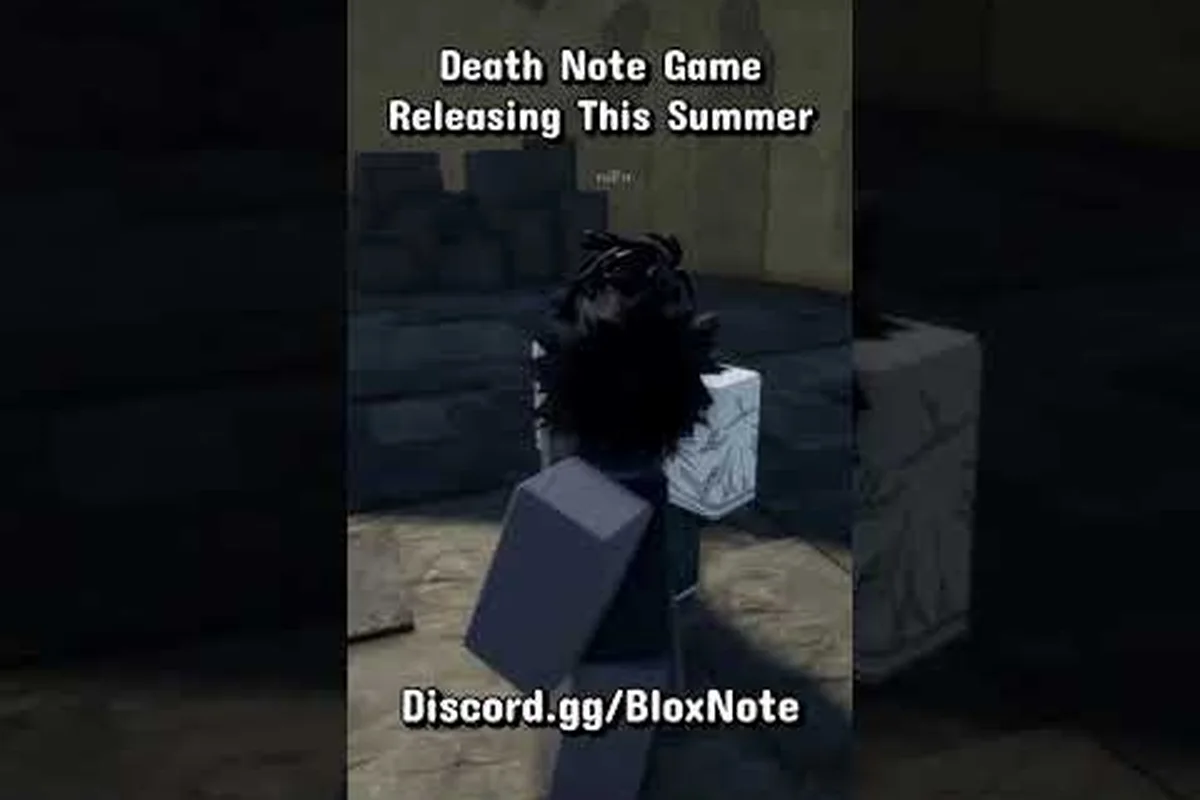
BloxNote Yagami is the central figure around which the entire Kira case in Roblox's BloxNote rotates, and understanding his role is the fastest way to read the rest of the character roster. The Roblox social-deduction experience, developed by fearless horror games and released on 2026-09-04, borrows its core cast almost directly from Tsugumi Ohba's Death Note manga, and the Yagami line anchors the killer side while Ryuk, Near, and Mello keep the investigator side alive. Each of those successors is more than a reskin — they carry distinct mechanics, motivation, and a slice of the original Kira case lore that the Roblox experience preserves almost beat for beat.
BloxNote Yagami and the Kira Role Explained
BloxNote Yagami is the name most players hear first because the game literally borrows Light Yagami's identity for its killer faction. The Kira side is built around a single notebook mechanic: the player holding the Death Note has to learn a target's real name before they can write it down, and the steal-an-ID sub-loop forces interaction between Kira and Investigators. According to the Light Yagami Wikipedia article, the manga's protagonist is a high-achieving student who finds the notebook and becomes Kira — a setup BloxNote mirrors almost directly. The role plays out the same way it does in the original case: methodical, hidden, paranoid, and always one misstep away from being unmasked by the next detective.
How the Yagami Identity Plays In-Game
When a round opens, the Kira role is assigned to one player who becomes the BloxNote Yagami equivalent for that match. The holder of the Death Note receives the notebook passively rather than picking it up, which removes the early-game chase that similar social-deduction games force on the killer. From there, three sub-loops define the role:
-
Name discovery — Kira has to learn a real name from chat, the public player list, or the Shinigami Eyes tool before writing.
-
Write-and-wait — once a name and a cause of death are entered, the round tallies the kill after the scripted timer; Kira is invisible during the wait, which mirrors the manga's "Kira is calm while the world panics" pacing.
-
Cover-up pressure — every kill raises the suspicion meter among Investigators, and the holder of the Death Note must deflect or pin blame on a Kira Follower to survive.
This is the BloxNote Yagami play pattern in practice, and it is also why fans of the source material keep the role populated. The role captures Light Yagami's methodology—cold composure, long-range kill planning, social misdirection—without forcing a player to read 12 volumes of setup, since the notebook, the Shinigami Eyes sub-loop, and the suspicion-meter pressure arrive pre-baked into the Kira assignment during round initialization, so newcomers can roleplay Light's calculated menace from their first match rather than grinding unlocks to access the Death Note's write-and-wait timing.
Yagami Compared to Other Killer-Side Roles
The Kira side is not a one-character faction. BloxNote splits the killer team into two seats so the role can be filled even when the original Kira is eliminated mid-round. The table below shows how the BloxNote Yagami main-Kira role differs from the supporting Kira Follower seat.
| Attribute | BloxNote Yagami (Main Kira) | Kira Follower |
|---|---|---|
| Starting item | Death Note (notebook) | No notebook — inherits only if Kira dies |
| Win condition | Outlast Investigators, eliminate L | Survive long enough for Kira's plan to land |
| Information access | Full notebook, can use Shinigami Eyes if unlocked | Restricted — must ask Kira for targets |
| Visibility to Investigators | High after first kill, low before | Always low, used as misdirection |
| Successor rule | Passes notebook to Follower on death | Promotes to active Kira on Kira's death |
This split is one of the cleanest adaptations of the manga's Kira/Misa dynamic in any Roblox title, and it is the structural reason the role feels distinct from a generic "killer wins if not caught" loop. Because the Death Note physically transfers to the BloxNote Misa-style Follower seat on death, the killer team never collapses into a single fragile win condition the way Near or Mello solo-killer variants do; instead the investigation pressure is split across the full session, and the Successor rule even lets a hidden Follower inherit Shinigami Eyes access mid-round if Yagami unlocked them before dying. That handoff is also why the Follower's "low visibility" column in the table above matters strategically — Investigators who tunnel the loud Main Kira can suddenly find themselves staring at a fully-loaded notebook held by a player they never flagged, which is the exact narrative beat the BloxNote Ryuk-flavored spectator framing was designed to enable.
BloxNote Ryuk and the Shinigami Connection
BloxNote Ryuk is the in-game Shinigami observer, and he functions as the silent narrator of the Kira case. In the original manga, Ryuk is the Shinigami who drops the Death Note into the human world out of boredom, then watches Light's descent for entertainment. BloxNote keeps that exact relationship: the notebook spawns because Ryuk drops it, and the Shinigami role stays in the round as flavor rather than as a target. Players who queue into the Shinigami seat become ambient witnesses, which is closer to the manga than to a typical "third faction" design.
What Ryuk Actually Does in a Round
The Ryuk slot is not a play-to-win role, but it is far from useless. According to the game's terminology dictionary, Shinigami Eyes are a community shorthand for the visibility power the Shinigami role sometimes grants, and the lore angle explains why the role is present at all. Practical functions the Ryuk seat provides:
-
A visible anchor for the notebook narrative — players know why the Death Note exists in the round.
-
Ambient dialogue that often hints at the Kira's identity without naming them outright, similar to Ryuk's constant commentary in the anime.
-
A non-combat role for players who want to enjoy the BloxNote lore without the pressure of either faction.
Because the Shinigami does not score, the seat is the most casual way to experience the BloxNote lore without committing to a faction, and it is the recommended starting point for players who are still learning how the notebook and the steal-an-ID loop interact.
Ryuk's Role in the Case Frame
The structural reason Ryuk exists in the round is to keep the manga's narrative frame intact. Death Note, both as a manga and as a Roblox adaptation, is told partly from Ryuk's point of view, and removing that voice would collapse the case framing. BloxNote keeps it because the role answers a question every new player asks within their first round: why is the notebook here at all? Ryuk's presence in the match resolves that question without a tutorial pop-up, and it preserves the manga's wry, slightly detached tone. For a deeper breakdown of how the Shinigami powers feed into BloxNote lore, the shinigami eyes lore guide walks through the visibility rules in more detail.
BloxNote Near and Mello as L's Successors
BloxNote Near and BloxNote Mello are the two successor slots that activate the moment the L role is eliminated. This is one of the most faithful structural lifts from the original Death Note case, because in the manga, Near and Mello are the two children raised at Wammy's House who eventually inherit L's work. According to the Near Wikipedia article, Near is the methodical successor who eventually closes the case on Kira, while Mello works a rougher, more impulsive angle. BloxNote encodes that personality split directly into the two successor roles, which is why the BloxNote lore feels surprisingly faithful even in a Roblox social-deduction wrapper.
How the Successor Mechanic Works
The Investigator side is built on a single hard rule: when the L player is removed from the round, the role does not disappear — it transfers. The two candidates for that transfer are Near and Mello, and the player who promotes depends on the order in which the L role dies and the queue state. The full mechanic looks like this:
-
Round opens with L assigned to one player and a queue of two successor candidates tagged Near and Mello.
-
If L dies before the round ends, the first successor in the queue inherits the L toolkit and the L name plate.
-
If that successor also dies, the second candidate promotes and the round continues with the original L's investigation still active.
-
The Kira side scores only when the final successor is also removed, which is the closest BloxNote gets to the manga's "you must beat the case, not just the face" feel.
This successor system is also why the BloxNote lore reads as a case file rather than a chase: even when the lead detective falls, the case keeps moving. A Kira team that successfully downs Light Yagami still inherits the full L dossier — meaning Near inherits not just the toolkit and name plate but also any partial investigation, intercepted calls, or hidden evidence that Light had half-decoded before death, so the Kira side must now defeat an opponent who knows their prior patterns. A common BloxNote scenario is the L → Near handoff on round 2, where Near inherits a near-complete investigation and then passes the open lead directly to Mello on round 3, forcing Kira to neutralize two informed successors in sequence rather than one.
How Near and Mello Differ in BloxNote
The two successors are not interchangeable, and the table below summarizes what each brings to the round. Near inherits the full L toolkit alongside methodical deduction hints, which lets a slow investigator mirror the manga and close the case cleanly when the write loop runs long. Mello, by contrast, sheds most of that toolkit but gains a personal intel action that forces the Kira side to react under time pressure, trading survivability for momentum.
| Attribute | BloxNote Near (First Successor) | BloxNote Mello (Second Successor) |
|---|---|---|
| Inherited toolkit | Full L tools plus methodical deduction hints | Reduced L tools, but a personal intel action unique to the role |
| Play style | Slow, evidence-first, mirror of the manga's Near | Aggressive, off-book, willing to take losses to expose Kira |
| Strength | Closes the case cleanly if the round goes long | Forces the Kira side to react under time pressure |
| Weakness | Can be outpaced if Kira finishes the write loop early | More likely to be eliminated by Kira before a clean conclusion |
| Narrative parallel | The detective who solves the case on paper | The detective who takes the loss so the case can be won |
Players who want a longer walkthrough of how the successor queue actually promotes in a live round can read the BloxNote successor mechanics breakdown, which sits next to this character page in the wiki tree. That guide explains the exact order in which the L toolkit passes from the first successor to the second after a write-loop failure, the soft-respawn timer that gates Near's promotion, and the intel-action cooldown that Mello inherits once Near is eliminated mid-round.
BloxNote Misa and the Kira Follower Slot
BloxNote Misa covers the supporting killer role, and the way the game handles her mirrors how the manga treats Misa Amane: a second Kira, not a copy. In the original Death Note, Misa is the second Kira who works in parallel with Light, gets captured by Near's trap, and eventually forces the Yagami plot forward through her devotion rather than her deduction. The Roblox adaptation maps that onto the Kira Follower seat in a way that keeps the relationship between the two killer roles distinct from a simple "second killer" duplication.
Why the Follower Role Exists
The Follower role exists for three reasons that are easy to miss until a player runs a few rounds. First, it keeps the killer side competitive after the main Kira is eliminated, which is the most common round state in a 13-player match. Second, it preserves the manga's Misa arc, which is part of the BloxNote lore the developer has openly committed to keeping intact. Third, it gives the game a way to seed misdirection: a Kira Follower who acts independently can draw Investigator attention away from the real notebook holder. According to community testing reported by players, rounds where the Follower is played actively run noticeably longer than rounds where the Follower stays passive, because the Investigator side has to clear two names instead of one.
Misa and the Yagami Relationship In-Round
The Follower role is not a rival to the main Kira; it is a partner with a defined duty. The table below captures how the BloxNote Yagami main-Kira role and the BloxNote Misa-style Follower seat are expected to interact during a round.
| Phase | Yagami (Main Kira) Action | Follower (Misa Role) Action |
|---|---|---|
| Opening | Write first target with discovered name | Stay visible, deflect attention |
| Mid-round | Trigger Shinigami Eyes if unlocked, plan second write | Take a small suspicious action to keep pressure split |
| If Yagami is eliminated | Notebook passes to Follower automatically | Promotes, inherits the Death Note, becomes active Kira |
| If Follower is eliminated first | Yagami continues, but loses the misdirection buffer | Round continues with no Follower safety net |
That last row is the practical reason a BloxNote Misa-style player matters. Without the Follower alive, the main Kira has no buffer between themselves and a final Investigator push, which is one of the clearest examples of how BloxNote lore shows up in actual match outcomes.
How BloxNote Lore Connects the Whole Cast
BloxNote lore is not a backstory the developer tucks into a codex — it is the connective tissue between every role, every mechanic, and every round outcome. The cast in this game is structured so that each role points back to the original Death Note case, and the round loop itself is a compressed retelling of the Kira arc. The Yagami lead is Light, the Shinigami Ryuk is the narrator, Near and Mello are the successor detectives, and Misa is the second Kira. A new player can sit in any of those seats and still feel the shape of the original case file. The BloxNote lore also surfaces in the small design choices: a notebook can only be used after a real name is learned, because the manga's "you must know the name to kill" rule is the central plot device, and the Shinigami Eyes tool is gated behind progression because the manga treats that power as a serious escalation rather than a starter perk.
Round Flow as a Compressed Case File
If a player watches a single round from the lobby rather than from a faction seat, the round reads almost like a manga chapter: a discrete arc with a clear Shinigami cold-open, a Death Note handoff to the BloxNote Yagami lead, an L investigation that may pass through Near or Mello, and a final verdict that either vindicates or dooms the Kira side. The compression is what makes the loop feel narratively complete, because the win-condition states, role pass-down rules, and elimination timers are tuned so that even a 10–15 minute match covers the full Light-vs-L emotional arc that the source material stretches across dozens of chapters.
-
The Shinigami role opens the round with a notebook drop, mirroring Ryuk's first appearance.
-
The BloxNote Yagami lead receives the Death Note and starts the investigation that will eventually target them.
-
The L player gathers evidence and narrows the suspect list, which is the L arc in miniature.
-
If L falls, Near inherits, then Mello, which compresses the entire Wammy's House storyline into one match.
-
The Kira side either wins by eliminating the final successor or loses when the case closes, which mirrors Light's eventual defeat.
This is the reason the BloxNote lore feels unusually tight for a Roblox social-deduction game: the round is the case, and every mechanic maps to a chapter. For players who want the broader cast, the BloxNote Yagami character profile covers the killer side in more depth and links out to the rest of the cast pages.
Why Ryuk's Role Matters to New Players
A new player who understands the Yagami-Ryuk-Near-Mello-Misa loop will learn the mechanics faster than a player who treats each role as an isolated seat. The BloxNote lore is also the simplest way to remember what each role is supposed to do, because the manga does the remembering for you. If a player can recall how Near and Mello took over L's case, the in-game successor mechanic becomes self-explanatory. If a player remembers that Misa was the second Kira, the Follower seat stops feeling like filler. Players who are still choosing a starting role can get a structured walkthrough from the BloxNote beginner guide, which lays out the same cast from a round-flow angle.
Frequently Asked Questions
Is BloxNote Yagami the same character as Light from the manga?
Yes. BloxNote names its main Kira role after Light Yagami and ports his core trait — needing to learn a target's true name before writing it in the notebook — directly from the source material. The role plays out the same methodical, paranoid pattern that defines the original Kira case, so fans of the manga will recognize the behavior immediately.
What does BloxNote Ryuk actually do during a round?
Ryuk fills the Shinigami observer seat, which is a non-combat role that frames the narrative and occasionally hints at the Kira's identity through ambient dialogue. The seat exists to answer the in-universe question of why the Death Note is in the round at all, and it doubles as a low-pressure way to experience the BloxNote lore without joining a faction.
How are BloxNote Near and BloxNote Mello different?
Near inherits first when the L role is eliminated and plays a methodical, evidence-first style, while Mello promotes second and plays a more aggressive, off-book style that often takes losses to expose Kira. The split mirrors the Wammy's House rivalry from the original Death Note, and the two roles are not interchangeable in a live round.
Does BloxNote Misa take over if the main Kira dies?
Yes, but only as the Kira Follower. BloxNote Misa is the supporting killer seat, and when the main Kira is removed, the Follower inherits the Death Note and becomes the active Kira. Without the Follower alive, the main Kira loses the misdirection buffer that keeps Investigator pressure split.
Where does the BloxNote lore come from?
The BloxNote lore is a structural lift from Tsugumi Ohba's Death Note manga and its anime adaptation, adapted by fearless horror games for the Roblox social-deduction format. The round loop itself is a compressed retelling of the Kira case, with each role mapped to a character or arc from the original source.