
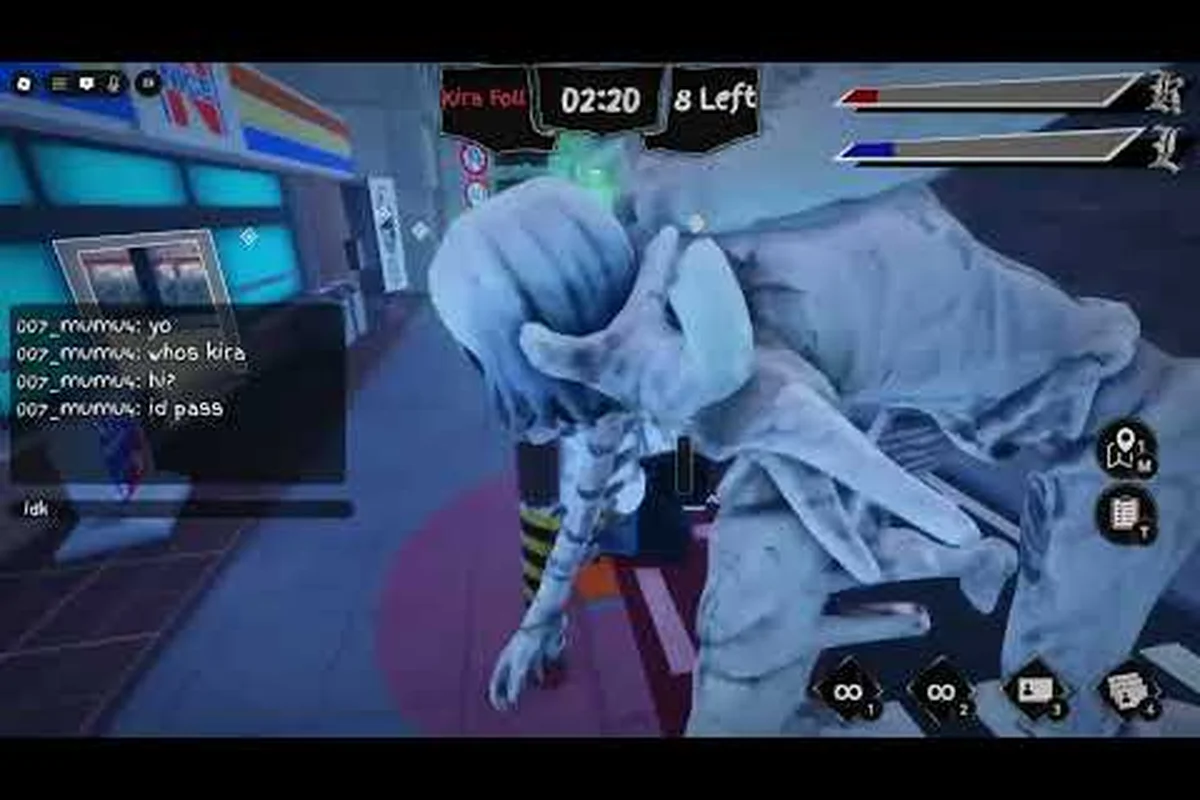
BloxNote is the Roblox social deduction game inspired by Death Note, and memorizing the full BloxNote game rules is the fastest way to stop dying in the first three minutes of a match. Whether you load in as Kira, a Kira Follower, an Investigator, or L, the rulebook decides who wins — and most early losses come from players who never read past the loading screen. This BloxNote guide 2026 walks through every rule that actually matters on the server right now, so your first round ends in a vote, not a notebook page.
The game drops a 10-player lobby into a single shared map, hands out four asymmetric roles, and forces one side to either write a name or solve a murder before the round timer expires. The rule layer underneath that premise is what makes BloxNote worth playing as a long-term social deduction game, and it is the layer most BloxNote wiki pages only sketch over. Below is the rulebook the way experienced players actually explain it, with the numbers, thresholds, and edge cases pulled from the current 2026 build.
Every Role's Win Condition Explained
Every BloxNote round begins with a role reveal, and the four roles split into two camps with mirrored objectives. Reading the BloxNote game rules without understanding the camp split is the single most common reason new players vote against their own team. The camp layer is what every meeting and every kill ultimately serves.
| Role | Camp | Primary Objective | Defensive Tool |
|---|---|---|---|
| Kira | Killers | Reduce Investigators + L to a clear majority | Holds the Death Note |
| Kira Follower | Killers | Protect Kira, deliver the notebook | Carries spare pages |
| Investigator | Town | Complete the shared task meter | Can call meetings |
| L | Town | Identify Kira before the kill count wins | Sees partial role data |
The Killers win when the combined Kira + Follower count equals or exceeds the remaining Town count. The Town wins when every Killer is voted out at a meeting, when Kira is killed mid-round, or when the task meter is fully completed before Kira reaches the kill threshold. The shared task meter is the single biggest counterweight to the Killers, and ignoring it is how Town teams bleed out without ever calling a vote.
Kira is the only role that can write a name into the Death Note, and writing a name triggers an instant kill after a short death animation. The Follower cannot write names but can hold a page, pass the notebook, and act as a decoy during meetings. Investigators look identical to Followers on the role card, which is the central bluff mechanic in the BloxNote game rules. L is a unique slot — there is only one L per match, and L's win condition is identical to the Investigators but with extra intel tools.
The role reveal happens during a short blackout phase right after the loading screen. The role card never shows another player's role, so the only way to learn the enemy team's identity is through the meeting system or the L-specific investigation tools. If you want a deeper breakdown of how L's intel abilities play into the camp split, the L role abilities page covers the exact timing windows and ID-grab rules.
How the Death Note, Tasks, and Kill Timer Actually Work
The BloxNote guide 2026 reading order matters here: the Death Note is the offensive engine, the task meter is the defensive engine, and the kill timer is the pressure gauge that forces them to collide. Understanding how all three tick at the same time is the real skill check, and it is what separates a 30% winrate player from a 55% winrate player in their first ten matches.
The Death Note Kill Sequence
When Kira writes a name, three things happen in sequence. First, the target sees a brief flash on their screen. Second, the target's character plays a death animation roughly 3-4 seconds later. Third, the kill registers on the shared kill count that appears at the top of the HUD. Kira must have physical proximity to the target at the moment of writing — there is no long-range kill — which is why good Kira players chase targets into low-traffic rooms before writing.
The notebook changes hands. If Kira drops the Death Note (either by choice or by being voted out), the Follower can pick it up and the next Kira is determined by a server-side handoff rule. In standard public lobbies, the Follower cannot write names — only Kira can. This rule is sometimes confused in community guides, so the current BloxNote wiki consensus is clear: only the active Kira slot writes names, and the Follower is a courier.
Task Meter Rules and Progress Thresholds
Investigators generate progress on a single shared task meter that all Town players can see. Tasks appear as small interactable icons scattered across the map, and each completed task adds a fixed percentage to the bar. Reaching 100% triggers an immediate Town win, which is why experienced Town players often ignore meetings entirely in the early game and farm tasks instead.
| Task Type | Approx. Meter Value | Time Cost | Best Role Fit |
|---|---|---|---|
| Short Task | 5-8% | 8-12 sec | Investigator |
| Long Task | 12-18% | 20-30 sec | Investigator with cover |
| Group Task | 10% per player | 15-20 sec | All Town in one room |
The task meter resets to 0% at the start of every round, so progression is per-match and not persistent. This is a BloxNote game rules detail that catches new players who assume the meter is a server-wide unlock.
The Kill Timer and Meeting Pressure
The match timer defaults to around 8-10 minutes in public lobbies, and Kira's win condition scales with how fast kills land. If Kira reaches the kill majority before the timer ends, Killers win instantly — no meeting required. This is why Kira players who write three names in the first 90 seconds often close out a round before Town even completes a single task chain.
Meetings are the only way to slow the kill timer, and they freeze the clock until the vote resolves. Each player gets one report button (used to call a meeting on a body or an emergency button) plus a vote. The majority vote threshold for ejecting a player is a simple majority of living players, not unanimity. If five players are alive, three votes eject — and abstaining counts as not voting, which is why undecided players often sink Town's own majority.
Meeting Rules, Voting Thresholds, and the Report Button
The meeting system is the only structured communication window in BloxNote, and the BloxNote game rules treat it as both a defensive tool for Town and a deception window for Killers. Most rounds are decided in the first two meetings, and most players do not actually know the threshold math, which is why they skip votes they should be casting and cast votes they should be skipping.
How to Call a Meeting
There are two ways to call a meeting. The first is the emergency meeting button, which every player gets once per round and which costs no in-game resource. The second is reporting a body, which can be done any time a dead body is visible on the map. Reporting a body and pressing the emergency button both open the same meeting UI, but reporting a body gives the reporter a small speaking priority window, which experienced Town players use to direct the accusation.
Kira cannot write a name during a meeting, and the kill timer pauses while the meeting is open. This is the single most important defensive mechanic in the entire BloxNote guide 2026, because it means a well-timed meeting can completely stop a Kira kill streak if Town uses the frozen window to vote out the right player.
Voting Thresholds and Ties
| Living Players | Votes Needed to Eject | Tie Result |
|---|---|---|
| 10 | 6 | No eject (status quo) |
| 8 | 5 | No eject |
| 6 | 4 | No eject |
| 5 | 3 | No eject |
| 4 | 3 | Eject triggers |
| 3 | 2 | Eject triggers |
The rule change at the 4-player threshold is one of the most-missed BloxNote game rules. Above 4 living players, ties kill the motion and nobody is ejected. At 4 or 3 players, a simple majority is enough to eject, which means late-game meetings are far more lethal than early-game ones. This is also why experienced Killers try to keep the alive count at 5 or higher — every meeting becomes a coin flip on a tie.
Skip Vote and Speaking Order
The skip vote option appears alongside every player's name, and choosing skip means you abstain from the current motion. If the majority of living players skip, the meeting ends with no ejection. Kira and Follower players often use skip votes to stall the meeting clock, because each second spent in a deadlocked meeting is one second the kill timer is paused.
Speaking order during meetings is randomized at the start of each meeting, and there is no fixed rotation. The body reporter, however, always speaks first, which is a small but real edge for Town players who report their own kills strategically. For a fuller breakdown of how meeting behavior maps onto actual round strategy, the BloxNote complete guide has a dedicated section on lobby etiquette and meeting cadence.
Reading the Map, Spawn Pools, and Where Kills Happen
The map in BloxNote is small enough to cross in roughly 25-30 seconds at sprint, which means positioning matters more than map knowledge once you already know the layout. New players who try to learn the entire map in their first round usually end up learning nothing, so the smarter approach is to memorize the four or five rooms where the majority of kills and meetings actually happen.
| Room | Kill Frequency | Meeting Frequency | Best Use |
|---|---|---|---|
| Main Hall | High | Very High | High-traffic, avoid if Kira |
| Library | Medium | Medium | Kira ambush zone |
| Kitchen | Low | Low | Safe task spot |
| Rooftop | Medium | Low | Late-game Kira finisher |
| Basement | High | Low | Notebook handoff zone |
The Main Hall is the single most dangerous room on the map because almost every player passes through it within the first 30 seconds. Kira players who camp the Main Hall can write a name on a passing Investigator before the task meter even starts moving. The Library is the second-most common kill site because it has limited exits and a single long hallway, which is where the Daytra showcase round showed a textbook Kira ambush during the notebook-handoff phase.
The Basement is where the Death Note usually changes hands, and it is also where the Follower does most of their courier work. Town players who never visit the Basement during a round often miss the only witness window for a notebook handoff, which is why experienced Investigators path through the Basement at least once in the mid-game. If you want a full visual breakdown of every task spot, kill room, and meeting funnel, the BloxNote map guide 2026 maps every interactable on the current build.
Spawn Pools and First 30 Seconds
The first 30 seconds of a match are when the round is most often decided. Kira needs proximity for the kill, Investigators need cover to start tasks, and L needs to bait a single mistake. The standard spawn pool spreads players across the four map corners at the start of each round, and the first movement decision is usually whether to push toward the Main Hall (aggressive) or toward the Kitchen/Basement (defensive). Most Town players should pick defensive in round 1 and switch to aggressive once they have at least one confirmed read on a player's behavior.
Strategy Layer: How Each Side Should Play the Rules
Knowing the rules is table stakes. Winning consistently requires you to use the rules offensively, which means making decisions that force the other side into a position where the rule layer works against them. The strategy below is the layer most BloxNote wiki pages skip, and it is also where the gap between new players and experienced players actually opens up.
Kira Team Conduct Under the Rules
Kira's job is to write names without being seen writing them. The BloxNote game rules give Kira no cover once the writing animation starts, so every successful Kira round is built on a window of physical isolation. The most consistent strategy is the "two-room rule": Kira should never be in the same room as a witness for longer than two seconds, which means writing a name in a 1-2 second window and immediately relocating. The Follower's job is to absorb a single vote, which they can do by playing aggressively in meetings and drawing the Town's suspicion away from the real Kira.
A second Kira strategy is the early-task feint. Kira pretends to be an Investigator by walking toward tasks in the first 30 seconds, which buys them a clean alibi for the first meeting. This works best in public lobbies where most Town players have not yet memorized spawn-distance timers. It falls apart in coordinated lobbies where experienced players track who actually completed a task and who just walked past it.
Investigator and L Strategy
Investigators win by ignoring Kira until the task meter is far enough along that a single meeting can flip the math. The "task-first, vote-second" rule of thumb is correct roughly 70% of the time, and the remaining 30% is when a player is acting so suspicious that the meeting opportunity is too good to skip. The cost of calling a bad meeting is real — you burn your emergency button and pause the kill timer for nothing — which is why most Investigators should default to tasking in rounds 1 and 2.
L is the only role with a dedicated intel tool, and the L-specific rules are the most-missed layer in the BloxNote game rules. L can request an ID check on a player within a short proximity window, and the result is partial — L sees a yes/no on whether the target is a Killer, but only after a delay. The L strategy is therefore to bait Kira into a chase, trigger the ID check, and then call the meeting at the exact moment the result lands. For the full L ability list, the L role abilities page covers every intel tool and the exact timing windows.
L Versus Kira: The Core Duel
The L vs Kira duel is the central conflict the entire rulebook is built around, and it is the only matchup in BloxNote where both sides have asymmetric information about the same player. Kira knows they are Kira, L knows they need to find Kira, and the rest of the lobby is guessing. The L strategy that works in 2026 is the proximity ID stack: L walks near three players in sequence, triggers an ID check on each, and uses the overlapping results to narrow the suspect pool to one player before the second meeting. This works because Kira cannot fake an ID check result — the check is server-authoritative.
Kira's counter to the proximity ID stack is the Follower sacrifice. The Follower walks into L's proximity first and draws the ID check, which burns L's intel tool on a wrong target. This is why most successful Kira rounds in 2026 involve the Follower acting as a decoy in the first 90 seconds, and it is the main reason a 2-Killer team is significantly harder to solve than a solo Kira.
Frequently Asked Questions
What are the most important BloxNote game rules for a brand new player to memorize first?
The four highest-priority rules are the camp split (Killers vs Town), the kill majority threshold, the task meter as an alternate win condition, and the meeting voting threshold at 4 living players. New players who internalize only these four rules already beat the majority of first-round lobbies. Everything else in the rulebook is layered on top of these four mechanics.
How many players are needed to start a BloxNote match, and what is the max lobby size?
A standard public lobby needs 8-10 players to start, and the max lobby size is 10 in the current 2026 build. Smaller lobbies can start with 6-8 players in private matches, but the kill majority threshold and task meter scale down accordingly. The minimum-viable lobby for learning the rules is 6 players, which gives one of each role plus two extra Town slots.
Can the Kira Follower write names in the Death Note?
No. The Follower can carry pages, pass the notebook, and act as a decoy, but only the active Kira slot has write access. This is one of the most-missed BloxNote game rules and it is the reason new Followers often waste rounds trying to write names and exposing the team. The notebook itself stays a single item, and only the holder of the Kira role can activate it.
What happens if a meeting ends in a tie?
A tie means no player is ejected, the meeting closes, and the round resumes from where it paused. This is the standard rule at 5+ living players. At 4 or 3 living players, the same vote count becomes a majority, so the tie rule effectively flips at the late-game threshold. Most experienced Town players try to keep the alive count at 5 or 6 to keep the tie buffer alive.
Where can I find the most up-to-date BloxNote wiki and rule changelog?
The active community wiki and the creator Daytra's showcase round on YouTube are the two sources most players use to track rule changes between patches. The official Roblox game page also lists patch notes, and the BloxNote on Roblox page is the fastest way to confirm a rule change after a major update. For more on the underlying Death Note premise that BloxNote adapts, the Death Note Wikipedia article covers the source material that drives the role names and win conditions.